
| Upcoming Events |
| 2026 Fire & EMS Incidents | |
| Jan | 86 |
| Feb | 74 |
| Mar | 85 |
| Apr | 87 |
| May | 84 |
| Jun | 78 |
| Jul | 0 |
| Aug | 0 |
| Sep | 0 |
| Oct | 0 |
| Nov | 0 |
| Dec | 0 |
| Total | 494 |
| Web Counters | ||||||
|
|
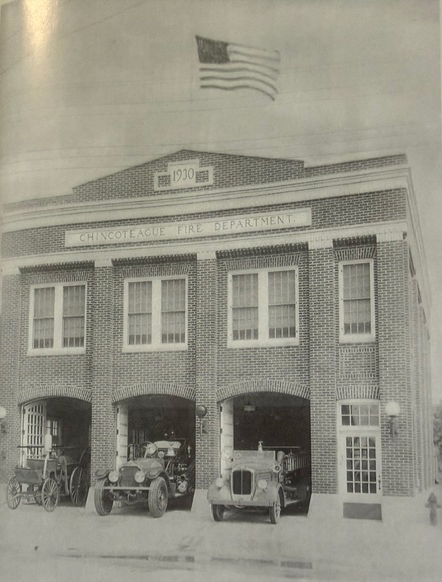
Historical Overview: 1905–1950 At the turn of the 20th century, the town of Chincoteague faced a growing threat—wooden homes, narrow streets, and limited access to fire protection made the island dangerously vulnerable. It wasn't until the destruction of several key buildings, including W.C. Bunting’s store and the “Pleasure Dome,” that the community galvanized into action. In 1905, residents gathered in the M.E. Church Community Hall to raise $25 to purchase basic firefighting equipment. A hand-pumped engine was acquired, and with bravery and buckets, local men managed to stop a devastating fire from spreading. However, the inadequacy of the island’s early firefighting resources was made painfully clear during a major fire on September 5, 1920, which destroyed 12 homes and businesses. Assistance from the mainland was delayed by geography and weather, and existing equipment proved ineffective. Out of this adversity, a committed group of 25 citizens formally established the Chincoteague Volunteer Fire Company in May 1924, beginning with just 14 official members. Their first purchase—a fire truck with a 750-gallon water tank and 2,000 feet of hose—was financed through community events, including the company’s first carnival and the now-iconic “Pony Penning Day.” By 1930, the Company had built a new brick fire station at a cost of $32,000, which was entirely debt-free by 1935. Subsequent investments included a 1936 GMC chassis equipped by American LaFrance, and later, amusement rides to support the fundraising carnival. The 1939 purchase of 80 ponies from the estate of Joseph Pruitt laid the foundation for what would become the world-famous Chincoteague Pony Swim and Auction. With the exception of World War II years (1943–1945), the Firemen’s Carnival has been held annually, serving as both a critical fundraising tool and a cherished community tradition.
| |||||||||||||||||||||||
.jpg)
.jpg)
.jpg)
.jpg)
.jpg)
.jpg)
.jpg)
.jpg)
.jpg)
.jpg)
.jpg)
.jpg)
.jpg)
.jpg)
.jpg)